Dead Line

The author says:

Two men. Two centuries. One destiny. Tom Dorin, a maimed and disillusioned veteran of the Civil War, builds a new life in the Arizona territory. Jon Hansen, a graduate student in Tucson, Arizona, finds an antique photograph in a decrepit roadside museum. A disturbing portrait of a long-dead man who could be his twin. Only two facts are known about the man in the tintype. His name was Tom Dorin. On March 13, 1874, he hanged. What begins as research into Tom Dorin’s life for a master’s thesis, becomes an obsession for Jon Hansen. An obsession that consumes every waking moment, and threatens every relationship in his life. Until the morning he wakes in Tom Dorin’s bed. In the Arizona Territory. On October 19th, 1873. Only one fact remains certain. It is recorded history, unalterable. On March 13, 1874, Tom Dorin hangs. No one knows why.

DEAD LINE Critique

DEAD LINE Critique

Nathan says:

What you’ve got here is well-rendered.  However, I think some changes to the initial idea are in order for the cover to attract readers like it needs to, for a story that is essentially “Somewhere in Time meets Back to the Future III.”  (Yes, that means a lot of work for you if you follow my critique. No, I’m not sorry.)

First: The strong red and blue elements of the cover call to mind not just a western, but a pulp western magazine from the thirties and forties. Since your story isn’t a standard shoot-’em-up, I think you may be giving the wrong impression and turning off the readers who would actually enjoy the story.

Second: The two different photos of the same face is a good idea in theory.  However, to really work, the pictures need to be in complete parallel, directly across from each other, with each taking equal visual weight.  Here, the tintype occupies much more space, but the isolated blue on the student ID, and the much starter monochrome in the modern picture, keep the two from being balanced. And while the cover makes sense once someone has read the synopsis, I don’t think it works the other way around, which is how it needs to work.  And I don’t know if monkeying with the balance between the two pics will fix it.

If someone handed me that synopsis and asked me to design a cover, here’s what I’d do: A sepia-toned western street with people in period garb, and in the very center of the illustration, a figure in modern clothes in full color, facing away from the reader.  I think the normal color at the center would draw the eye toward its natural center of focus, and the contrast between modern and period clothing would be very apparent, making it clear that this is a story about a modern man in the Old West.  (I’d render the title in a distressed western font.)

Anyone have different ideas?

Vandal Valkyrie

The author says:

A dark fantasy and cosmic horror novel, book 1 in a series. The main characters quest to bring justice to the dread lord of an evil nation. But all of their actions are orchestrated by titanic forces that move in the shadows of history, seeking terrible ends that these mortal pawns cannot begin to imagine or oppose. Synopses: The End of Days has come and gone. Horrors from beyond sanity lay siege to reality. In this world, Alfair and Paemani come of age fighting to build a nation in the perilous North Marshes. Centuries later, their scion the Princess Valkyrie crusades against the Mad Count of Harkenvold. But against the Horrors, the Mad Count may stand as the only true hope. The story follows Alfair, Paemani, and Valkyrie as they seek victories that may imperil creation itself and fight wars that they may desperately need to lose as the North Marshes rises to prominence in an utterly hostile world.

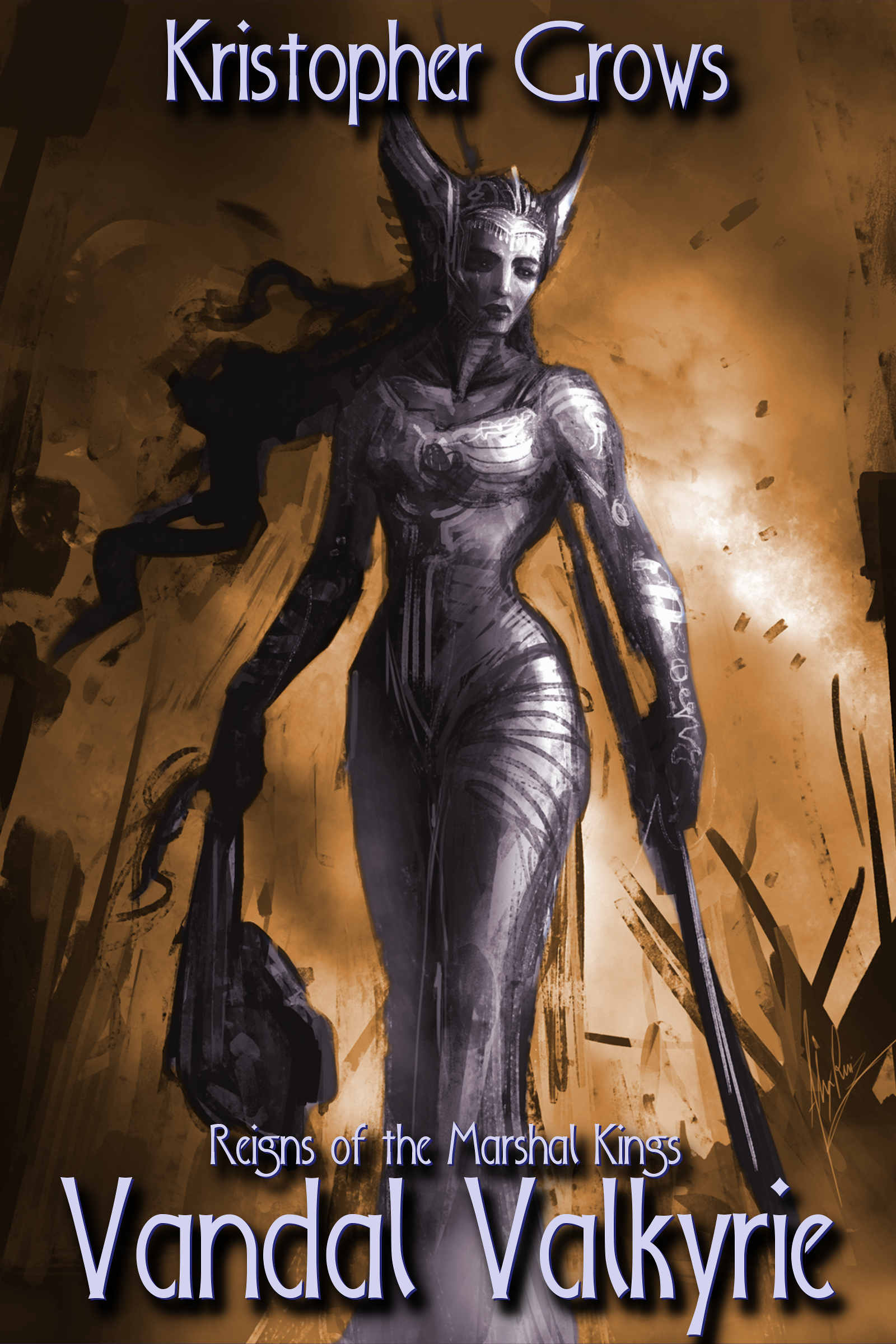
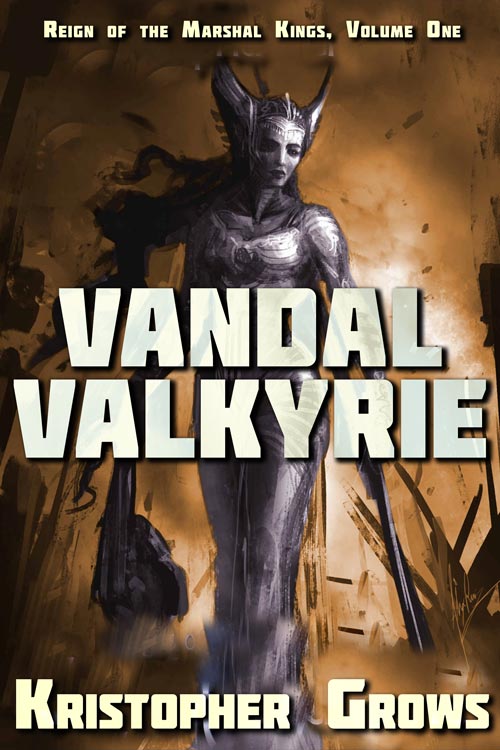
The art is a sketch by Alex Ruiz at Conceptmonster.net used with permission, my role was in colorizing and formatting it as a cover.

Vandal Valkyrie Cover

Vandal Valkyrie Cover

Nathan says:

The art is terrific — sketchy, of course, but still bold and evocative for all that. You made a good choice.

The type… not so much. Problems:

  1. Every time I see the type isolated into a section away from the art, I think, “This art obviously wasn’t commissioned for this cover — it was acquired, and then someone tried to make the type fit.” Which is exactly what happened here, but you don’t WANT it to look that way.  I took a look at the original art to see if you have any more room at the bottom. You do. USE IT. You could place the byline at the top, and the title and series title at the bottom. Or place the title across her midriff (the two focal points are her head, and the head in her hand). But get rid of that pasted-on blue box.
  2. Both fonts you chose are ornate enough to be hard to read.  I think that with “valkyrie” in the title and a warrior woman dominating the illustration, you don’t need the Norse-ness in the title typeface to sell the concept; concentrate on impact and readability instead. The same goes for the series title and byline: the smaller the type is, the clearer it needs to be in order to be read.

Other comments?

Locksmith’s Journey [resubmit]

The author says:

“Locksmith’s Journeys” is the sequel to the YA science fiction novel “Locksmith’s Closet.” Lachlan Smith and his immediate circle of family and friends continue their search of the future through the time portal to learn the secret of what happened to the human race. Back in the present, they learn who made the portal and why.

LJ cover version 1.3

LJ cover version 1.3

[original submission and comments here]

Nathan says:

Well, at least the paraglider is bigger…

It still lacks any excitement, any danger, any indication of genre or audience.  If I were to see this originally in thumbnail, I’d assume it was one of those “memoirs of my not-too-interesting life” volumes, because it all looks so peaceful.

Here’s my five-minute do-over:

LJ-cover-version-1

In addition to the obvious color change to a more “dangerous” hue, I also tilted the paraglider, because everything on this cover was so square that the contrast is appealing, and diagonals give an impression of instability and dynamism.

But I still don’t think it’s a good cover, and I don’t think this can become a good cover.  You’ve stepped away from the human figures on your first cover, which are definitely a better way to market to your audience than a distant paraglider.  You need to do that whole “Old Spice” thing: Look at successful YA books covers, then at yours, then at other covers, then back to yours…

Anyone think I’m wrong?

The Order of Agrios / The Claustrophobic Heart

A special twofer!

The author says:

This literary novella is the first of a 3-part novella series.

Jacob Alderdice is the son and heir of the prominent San Francisco family. Although dearly loved by his sister Vivian, his philosophical and artistic lifestyle has made him a pariah to his tyrannical mother, Larissa.When the Alderdices take their yearly summer vacation to the prominent resort town of Waxwood, Jake meets Stevens, an older man with an obsession for leadership. He befriends Jake and introduces him to The Order Of Agrios, a group of misanthropes who have rejected the commercial and conventional luxuries of their former lives to live in the wild. Seduced at first by Stevens’ powerful and charismatic demeanor, Jake comes to realize that behind the man lies something more brutal and sinister.

Any feedback would be much appreciated!

OOA Novella Cover Final

OOA Novella Cover Final

The author says:

This literary novella is the second of a 3-part novella series.

Gena Flax, abandoned by her mother at a young age, has built her life around caring for her guardian Helen, whose physical illness and mental peculiarities have reduced her to a childish, neurotic, and clinging woman.One summer, she gives her aunt a gift of the sea. She takes a room at the exclusive Waxwood Inn in Waxwood, California with money she has scrimped and saved from two jobs and her aunt’s disability checks. But the gift reveals the depths of mental deterioration, betrayal, and family secrets.

Any feedback would be much appreciated!

TCH Novella Cover FINAL

TCH Novella Cover FINAL

Nathan says:

I put both of these books in one critique, because series branding is a big deal, and they should thus be considered as one unit.

I’ve joked before that “literary” fiction covers go out of their way to look like they’re about nothing in particular. That’s obviously hyperbole, but the fact remains that lit-fic covers eschew anything which looks like an obvious pointer to a specific genre: No planets, no silhouette figures running down dark alleys, no half-naked headless couples embracing, no wolves. By that metric, the first cover especially succeeds: The art (public domain — Google Image Search tells me that it’s by Vilhelm Hammershoi, d. 1916) is both exquisitely accomplished and understated, and is quietly intriguing for readers who avoid the “crowd-pleaser” elements of popular fiction.

Using the first cover as the lynchpin of the series, then, we move to the second cover, and we run into some problems:

  1. Part of series branding isn’t just typeface, it’s type placement. Even though the position type on the first cover is largely dictated by the layout of the artwork, it’s also a good arrangement on its own. But to continue the brand, the same type placement should be used on the other covers in the series, which obviously limits the images you can use — you have to have something that will fit behind the predetermined type layout.  In eyeballing the second cover, I can see that mimicking the type layout of the first cover would put white letters across the lightest parts of the image — a liability for readability. But that’s okay, because…
  2. The image used for the second cover both isn’t good when considered by itself (it’s obviously a low-resolution image blown up to cover size with attendant problems, and the hues suggest that it was either poorly photographed to begin with, or it’s a print that hasn’t aged well), and doesn’t relate well to the image used on the first cover (a photograph instead of an antique painting).  Wouldn’t it be better to use another obscure antique painting — either another Hammershoi, or something that shows similar age and quiet reserve?

In short: The first cover looks deliberate, while the second cover looks desperate.  Make the second cover appeal to the same readers who are drawn to the first cover.

Other comments?

Arcadia’s Daughter

The author says:

Abigail Johnston died of scarlet fever on a remote farm in Maine in 1872. On the day of her death at 19, her grieving parents posed with her lifeless body for a memento mori, a picture of the dead taken by an itinerant photographer. The picture trapped her soul in Gehenna, a place of torment ruled by Queen Lilith, Adam’s disobedient first wife. A century later, David Austin, finds her photo in an antique store in rural Maine and becomes obsessed with discovering her identity. He finds her forgotten grave in a forest after an improbably lucky search. While he is holding her photo in the cool spring twilight, a woman steps out of the shadows and extends her hand to him. “Sir, I need your help.” It is Abigail. She has crossed over to the land of the living to ask David to find and destroy Moloch’s chalice, the supreme power talisman of the shadowy demon Aamon to prevent his consort Queen Lilith and her children, the Lilim, from annihilating humankind and occupying Earth. Abigail’s touch creates a psychic bond between them which grows ever stronger. David, fighting to overcome self-doubts, searches the world from Jerusalem to Idaho, following a gossamer trail of clues while being pursued by the Black Sun assassins. He is aided by a secret brotherhood founded by Moses dedicated to the destruction of the Lilim. In a classic hero’s journey, David realize his hidden courage, and risks everything to succeed.

FinalCover2

FinalCover2


Nathan says:

Aside from the gravestone, the historical photo of the girl is well composited into the foggy background.  My real complaints are:

1. Ditch the character quote.  It’s a lot of words that doesn’t actually tell us anything about the story.

2. Waaay too much empty space. There are lots of covers that have small focal figures on them, yes, but they either have a detailed or meaningful background or surrounding that conveys useful information, or isolate the character so starkly that the white space around them carries weight. Yours does neither.  You could trim it down to this size…

FinalCover2-Nathan

…and lose absolutely nothing. This also lets your name be larger because, hey, you wrote a book — there’s no reason to by shy about it.

Also, a slight drop shadow or dark halo would make the yellow title stand out against the pale background.

(I know it’s not germane to the discussion of your cover, but your “elevator pitch” needs plenty of work. It takes forever to get to what the actual meat of the story is.)

Other comments? (Only about the cover — I don’t want the entire thread to be dominated by a discussion of the description.)