The author says:
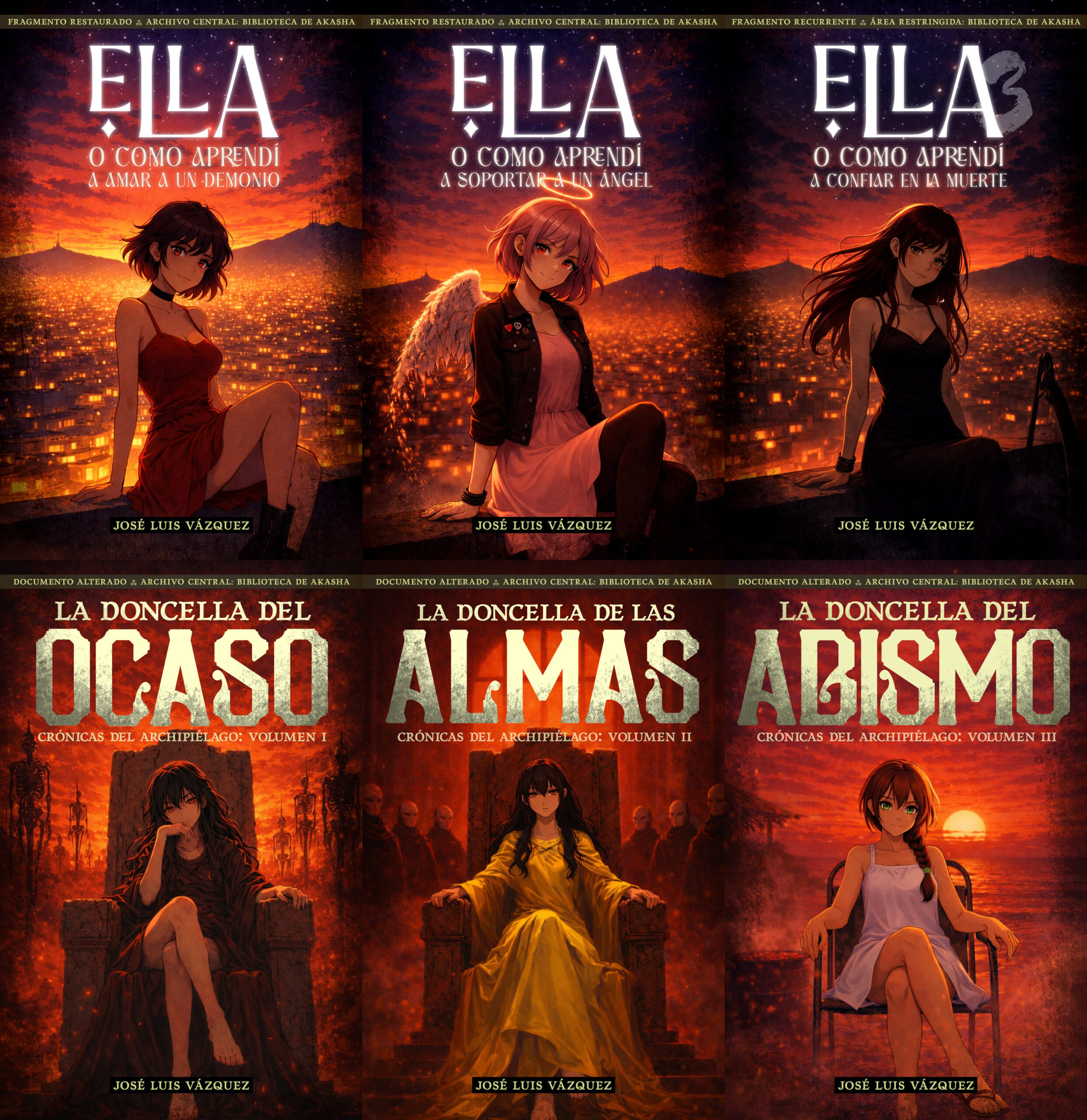
Hello, everyone. I am writing a dark fantasy book series (?) that sets in Mexico. Mixing a lot of prehispanic and european folklore. I am doing a rebranding (and a heavy edition) of all my books (30+) and I want to unify the look of my covers. These are my main series, the gates to my books. All the other books, while related to these, are standalone stories featuring important characters from this series. What do you think about them. I don’t want the covers to say “hey, this is mexican Lore” that’s why I don’t use any symbology related to prehispanic Mexico, but I want to give the idea of “hey, this is like a light novel”. Do you think it works? There’s room to improve? Thank you in Advance.
Nathan says:
I’m always a little leery of commenting on covers for a foreign-language audience, as I might miss some of the visual cues that are common to another culture.
My only comment here is that using anime-influenced art might limit your audience. I know that I personally avoid books with anime covers, as I assume they’re aimed at people devoted to — or at least more familiar with — the storytelling tropes of that genre.
Other comments?
The distinctly anime/manga style works directly against your goal of suggesting a link with Hispanic/Mexican folklore. I would abandon this and try to go with something that conveys a more traditional style. Perhaps look at the art of classic Mexican artists such as Rivera, Bustos, Orozco, Tamayo, etc. (And I have to ask: was AI involved in these covers?)
Technically, anime and manga aren’t really a “genre” as such, but a stylistic medium for storytelling that originated in Japan. Having viewed a fair amount of anime (and a smattering of manga) myself, I can testify that the medium covers all kinds of different genres from child-friendly fantasy and family-friendly situational comedies to mind-bending experimental stuff to raunchy romantic comedies to adult works that would put Game of Thrones to shame for how much blood-soaked violence and out-and-out pornographic content they have. That said, employing this particular medium in any context does tend to raise expectations that certain tropes unique to the Japanese culture will come with it; if you then give your audience something completely unrelated to the Japanese culture with all of its mindsets, it will rightly perceive you to be a poser who’s pulling some kind of bait-and-switch “false flag” tactic on your readers.
I understand that you wish to rebrand your book series to give it a broader appeal in order to expand your readership, but if anything, employing a distinctly Japanese stylistic medium on your covers will only serve to constrict your readership (specifically to Spanish-speaking fans of anime and manga who won’t feel too betrayed when they discover there’s nothing Japanese about your books at all—a terribly tiny niche indeed, I must say). For a broader appeal, you need to use a more generic style that isn’t so unique to any particular nation’s culture. I’m not saying your book needs to be everything to everybody, but I am saying it needs to be immediately accessible to multiple cultures across multiple nations.
To this end, I suggest you focus not on keeping distinctly pre-Hispanic Mexican stuff off of your covers, but on putting generic stuff on them that generally says “This is dark fantasy!” to all Spanish-speaking cultures around the world (i.e. Spain itself, some of its former colonies where some people still speak the language such as the Philippines, and all Spanish-speaking nations and regions in the Americas). Nobody will complain about any culturally specific stuff lurking on your covers as long as the main focus is on more generic dark fantasy imagery immediately accessible (i.e. comprehensible) to almost anybody who speaks Spanish.
In short: if you want to rebrand to broaden the appeal, focus your covers’ imagery on the genre, not the setting. Once you’ve established in prospective readers’ minds that the books are dark fantasy, the setting (“Oh, so these stories take place in pre-Hispanic Mexico? All right, then.”) and length of the story (“Not a lot of pages; this must be one of those light novels.”) won’t bother them at all. Once prospective readers understand your books’ general subject and tone, the specific details (such as the setting and the cultural nuances thereof) will take care of themselves.