The Precocity Virus

The author says:

In the near future, an asymptomatic and universally contagious depopulation virus engineered to accelerate the aging of human female reproductive organs soon precipitates a worldwide baby bust, leaving civilization and humanity itself in danger of extinction if people in general can’t find some way to start having more children. While various individuals and institutions all over the world bicker endlessly about this crisis, the mothers from a pair of fairly ordinary neighboring families somewhere in rural Alabama come up with a working—albeit extremely illegal—solution: since they can’t have any more babies themselves, they’ll get the children they already have to do it for them. Thanks to several rather fortuitous circumstances (e.g. an illegal teachers’ strike shutting down Alabama’s schools for months on end), their plan succeeds, but what will happen when what they’ve done is inevitably exposed to public scrutiny?

While premised on a sterility plague something like the ones in Greybeard by Brian Aldiss, Children of Men by P.D. James, and Bumped by Megan McCafferty, this is mostly just erotic fiction with a light dusting of science fiction (i.e. the titular virus) taking place in a time no more apocalyptic or dystopian or violent than our present. In other words, the vast majority of the “action” takes place between the sheets; no car chases or firefights here. Since a lot of the main characters participating in this “action” are necessarily rather underage, I also thought it best not to show any of the main characters directly on the cover, other than symbolically using that chart showing the intertwining of their family trees.

(P.S. That Impact typeface is only a placeholder. While I know some of the posters for that Jodie Foster movie The Little Girl Who Lives Down The Lane used it, that’s getting to be half a century ago and it’s probably rather overused these days. If you critics can suggest a better one, I’m all ears.)

Nathan says:

I assume by “underage” we’re talking about teenagers, right?  Because portraying teenagers as sexy isn’t as uncommon as you think — look at all of the posters from ’80s movies about teens getting it on, or at least attempting to.

But here’s the other question: Is this comedic? Dead serious? All just sweaty humping?  Whatever it is, a “sexy” novel without a sexy cover is simply a mistake. Sex sells.  You’re completely burying the main attraction.

Toobs

The author says:

“Toobs” is a character-driven literary novel, set in the present day. Takes readers on a wild ride through the dark funhouse mirror world of “Munchausen by Internet syndrome”. Single-line description: “A website dedicated to exposing medical frauds causes a chronic illness influencer to question her own reality.”

Target audience is women 25-45 or so, comp books are “Self Care” by Leigh Stein, “Fitness Junkie” by Lucy Sykes, “Cover Story” by Susan Rigetti. It’s the type of book I’d like to see featured in Cosmopolitan Magazine summer beach read round ups.

Cover should convey “this is a dark, intriguing book about medical stuff”. Want to stand out among bright pink swirly and girly cut-paper or watercolor blob covers.

Nathan says:

I think the first problem is that you’ve set two targets — “character-driven literary novel” vs. “shocking, visceral and riveting” medical thriller.  I’m not saying that a medical thriller can’t be character-driven or have literary value, but those are two different shelves in the bookstore with different visual tropes to attract readers. (And neither of them are “bright pink swirly and girly.”)

The first step to making something look “dark” is… well, make it literally look dark.  (Or at least stark and contrasting.) It also helps distinct elements of the cover stand out, as opposed to the midlevel warm gray that the thumbnail becomes.

See what I mean?

And for heaven’s sake, ditch that title font. I get that it’s trying to convey “viruses” or whatnot, but it’s just goofy.

Other comments?

Lost in Starlight

The author says:

Genre: YA Sci-Fi Romance

Like any good journalist, Sloane Masterson, feels compelled to uncover all the facts after witnessing mysterious loner, Hayden Lancaster, perform several superhuman feats. But the truth might be more than she bargained for, and even more dangerous for her heart… Because even at Hayden’s insistence that their relationship must stay in the “friend zone,” their fierce attraction threatens to go supernova. And if they follow their hearts, there might be deadly consequences—Hayden’s intergalactic enemies could permanently erase Sloane’s memories. Now Sloane must make a choice…protect herself or forget the boy she loves forever.

Nathan says:

It certainly rounds the bases for the genre. I would only point out three things:

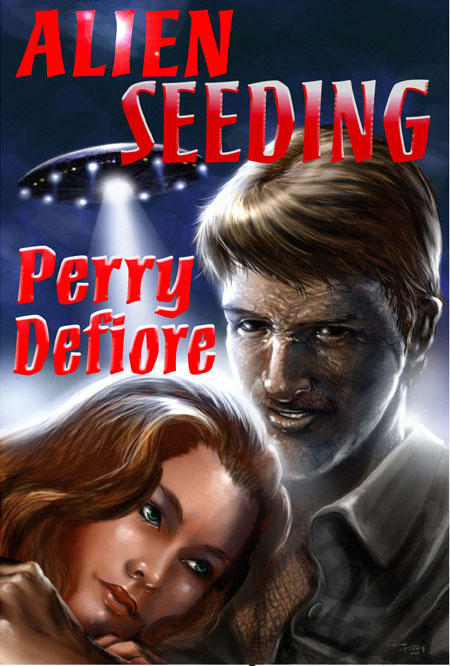
  1. That male model’s face is waaay too familiar. I wouldn’t be surprised if you found it on the books you’re marketing against.
  2. The difference in lighting schemes between the two models’ faces is pretty hard to ignore.
  3. Her hair is not only more stylized than any other detail on either head, it casts no natural shadow on her face; the result is that it looks pasted on.

Other comments?

Bloodlines

The author says:

BLOODLINES is a new adult, upmarket fantasy novel (part one of a duology). It follows two protagonists in the same city: Rorri, a refugee, drug addict, and hopeless romantic who falls in love with his magic tutor (which is where most of the cat-related things come from); and Pak, an outcast orphan boy with a tragic past, a cursed weapon that makes him do terrible things, a love for animals, and a crush on his only friend. Both are haunted by the distant antagonists in an ongoing war (people called the Duen) and both are subject to racial/class prejudice. Rorri has a secret (he screwed up bad), and Pak is searching for answers relating to the weapon, which ultimately ties to Rorri. Also they’re elves but like, lowkey elves, not Tolkien elves. Elevator pitches are hard 🙁

Target audience is 20-30 year old queer and neurodivergent fantasy readers (I plan to do targeted marketing via Facebook), people who like the Magicians Trilogy by Lev Grossman. It is both plot heavy and character motivated which is why I’m saying it’s upmarket.

I made the cover, my biggest concern is that the cats will throw people off. They’re mostly symbolic in the book, not necessarily a hard plot point.

Nathan says:

The problem isn’t the inclusion of the cats (although it took me forever to realize that the bottom cat was the reflection of the top one), it’s that nothing says “fantasy.” Cats can certainly be magical, and there’s nothing wrong with using them as your central image, but just including a cat doesn’t tell the reader that it’s a fantasy novel, and the typeface you chose has nothing fantastic about it either. Remember that, at the very least, your cover needs to immediately signal its genre.

This is something you could easily solve with (a) a different typeface, and (b) maybe a border.

But while you’re at it, please lose the posterizing filter — it adds nothing, only detracts.

Other comments?

The Slave Prince of Zimbabwe

The author says:

“The Slave Prince of Zimbabwe” is a historical-fiction novella set in the year 1200 AD. Our protagonist, Drazhan Khazanov of Ruthenia, has found himself forced into bondage and brought all the way from his homeland in eastern Europe to the Sultanate of Kilwa on the southeastern coast of Africa. His master the Sultan has offered him a chance at manumission if he can abduct the fierce and beautiful Mambokadzi of Zimbabwe. But when she foils Drazhan’s attempts to capture her and offers him an alternate path to the freedom he craves, they find themselves confronting the wrath of not only his former master but also the mightiest empire in the medieval world.

Will likely appeal to fans of action-packed adventure stories like those of Charles R. Saunders, Robert E. Howard, and Edgar Rice Burroughs.

Nathan says:

Action-packed adventure stories should look like action-packed adventure stories.  Howard and Burroughs had something important in common: Their paperback covers were beautifully illustrated by Frank Frazetta, whose artwork was dynamic and active.

Obviously, we can’t all be Frank Frazetta (in fact, only one person could be), but ACTION is needed on the cover of an action-packed adventure story.

If you need more inspiration that will work well with your style of colored line art, look at the covers of the classic Conan the Barbarian comics:

That’s art with adrenaline right there.

Go bold.