New Darwinian Laws For Every Business [resubmit]

The author says:

This is a resubmit, taking into account many of your suggestions. I also received some additional thoughts from Derek. Am I getting closer? Thanks again for your help and comments.
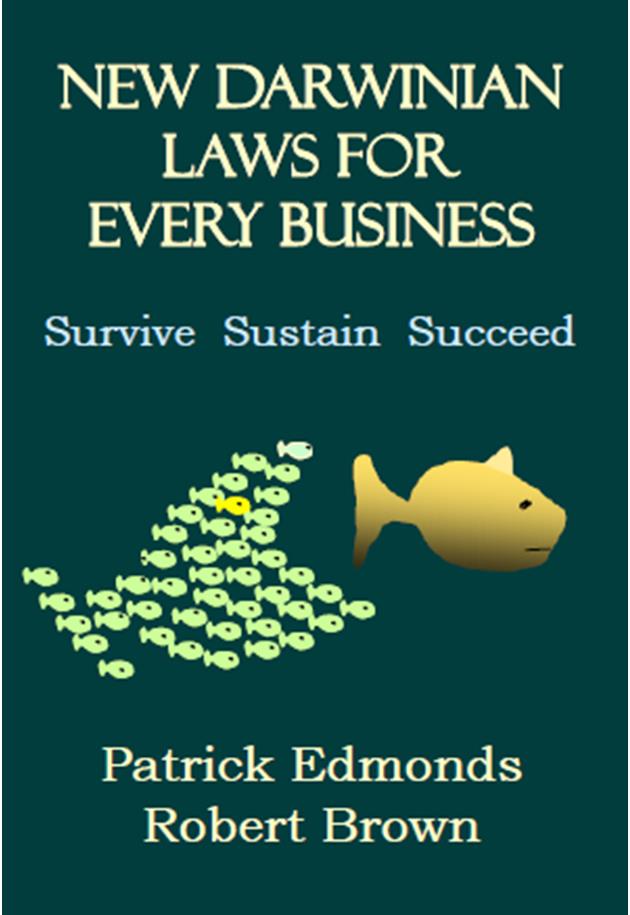
FrontcoverV15

FrontcoverV15

[original submission (as Survival of the Fittest) and comments here]

Nathan says:

Hmm.  The artwork is certainly less crude, though I don’t know that it’s still uncrude enough. And for what it’s worth, I disagree at least halfway with Derek, in his comment on the original post, regarding the need for a different title: I think that the wholesale replacement of the original title with “New Darwinian Laws For Every Business” is a mistake because, while it’s more accurately descriptive, it’s also more clinical and less evocative; not only is that less immediately appealling, it runs counter to the comment you made on that same post that you were indeed going for a “whimsical” approach.  Perhaps a longer, colon-divided title/subtitle — “Survival of the Fittest: What Your Business Can Learn From Darwin,” or somesuch — in which the subtitle is only slightly smaller than the title, and thus both are readable at thumbnail size.

Of the visual examples contributed, I really think that Viergacht’s mock-up is definitely the direction to go: it’s got that element of whimsy, it’s clean and clear, the text dominates and the image supports the title and effectively communicates the voice in which the book is (reportedly) written. Heck, I’ll reproduce it here because I think it’s that good.

Cux7rxs[1]


You can really see the appeal if you place your revised version beside his in thumbnail.  The cartoony vibe from his big fish really makes it for me:

FrontcoverV15 Cux7rxs[1]

I think that with a slight wording tweak so that the business aspect of the book is visible from the thumbnail, that’s really the way to go.

Other comments?

Invivo

The author says:

Invivo is a love story of honor, remorse and revenge, and one man who sacrifices everything to fulfill a promise. The story opens in a small university town in Scotland. Dr. Harold Spencer is arguing with his wife Shelly. She wants a child. He does not. Harold’s father and then his brother died of Cystic Fibrosis. He did not want an abbreviated, unhappy life for his child. He would not have children unless they could be healthy. His research was progressing. He promised they would not wait too long. Harold was deep into a bold experiment, injecting foreign DNA into a host animal, doubling the viable DNA. His approach promised miracles. So far, however, he had managed only to kill hundreds of rats, until one survived. A brutal murder ends all possibilities and results in one lost life, one given away, and one life allowed to blossom and quickly die. Harold found the one way he could keep his promise. Aimed at adult fiction readers.

Frontcoverlarge

Frontcoverlarge

Nathan says:

Minimalism is a tough gig. More than any other style of design, I have only by gut reactions to go by when saying whether something works or it doesn’t. I don’t think this works, and what follows is my attempt to reverse-engineer my gut reaction in intellectual terms.

1) I think most minimal designs work best when the lack of extraneous information lets a strong focus be put on one, and only one, detail.  In this case, I think that seeing the curve of the back distracts from the navel, which would otherwise be the obvious focus.

2) With very little to take away the focus from the type, it becomes imperative that the type be presented confidently.  That doesn’t mean that it needs to be gaudy or even ornamented with serifs, but I think the font you chose here gives more of a “chosen at random” feel than “chosen for strength.”  I hope that makes sense.

3) I’m nor sure from the description what the real focus of the story is, but I’m pretty sure that the cover doesn’t convey it.  Looking at the cover without the description, I may think that it has to to with the pursuit of physical beauty, and the title gives at least an indication that procreation is involved, but I don’t get anything remotely science-y or science-fiction-y, or murder-y.  Again, I don’t really know how central those themes are to the book, but they seem central to the description and yet absent from the cover.

Given that there’s a lot of image to work with here, I was to do one of my Five-Minute Makeovers to see what I could come up with.  But when I tried cropping the curve of the back and the text out of the photo, the navel over to the side wasn’t enough of a visual clue of what we’re seeing. I think you might want to find a different photo (it could even be something from the same modeling session) with the navel more toward the middle so that you can include the muscle and bone structure around it and have it be more recognizable.  An added bonus there is that you can play with the color more to indicate either the suspense-thriller or medical-science mood of the story, while not impinging on recognition of the navel.

I have now talked about navels more in the past twenty minutes than I have done in the last five years.

Anyone else?

Time Winders

The author says:

A time travel novel with a strong, female protagonist.

TW cover Critique

TW cover Critique

Nathan says:

Hmm. You didn’t give us a very big image to examine, so we can really only critique it as a thumbnail.  There’s only a very short description to compare it to, so forgive us/me if the advice we give doesn’t match the novel well.

First: Fonts. My rule of thumb is that, unless you have a compelling reason, try to limit yourself to two typefaces.  I don’t think you’ve got a compelling reason; what’s more, the most difficult-to-read font is used for your smallest text. (Another rule-of-thumb: The smaller the text is, the easier you should make it for the reader to read.)  And your largest type, your title, is in your most boring font.  I understand that big, bold sans-serif typefaces can appear strong, but I think this one misses the mark.

Second: Cover vs. description. All that we know about this time-travel novel, really, is that it has “a strong, female protagonist.” If that’s the most important thing you want the reader to get from your cover as well, then the image should concentrate on the female character more than the male; as it is, they have pretty much equal visual weight.  I don’t know if the original artwork has cropped-off portions; if it does, you might want to crop it differently so that the female is central and the male is off to the side and partially cropped.

Third: Layout.  The pattern you use — am image in the middle, completely separate from text above and below — is more often used for non-fiction than fiction books.  Again, if the original art allows it, I’d recommend the text go on top of the image.

Fourth: The words.  Maybe it’s just me, but I really dislike subtitles which essentially tell us the (sub-sub) genre of the book.  Maybe it’s because you see it more in crank-em-out erotica ebooks: “A Polyamorous BBW Shifter Billionaire Romance,” etc.  I’d recommend something more like “A Romantic Adventure Across Time” or somesuch — something that tells the reader about the contents without seeming like a taxonomic classification.

Fifth: The words, part two. I understand why you have “by” in front of your name; it’s such an unusual name that readers likely wouldn’t immediately identify it as the byline.  However, the “by” just seems like it sticks out there uncomfortably.  You could solve the problem by combining it with the tagline and putting it just above the byline — “A Romantic Adventure Across Time by” — instead of under the title.

I really want to do a five-minute mock-up to show you how these fixes would fit together, but the small size of the image you’ve given us doesn’t lend itself well to that.

Eh. what the heck.  Here’s something.

timerunners-2

These aren’t the fonts I would go with for the final, but I think this gets across all the ideas I was trying to spell out.

Anyone see something different?


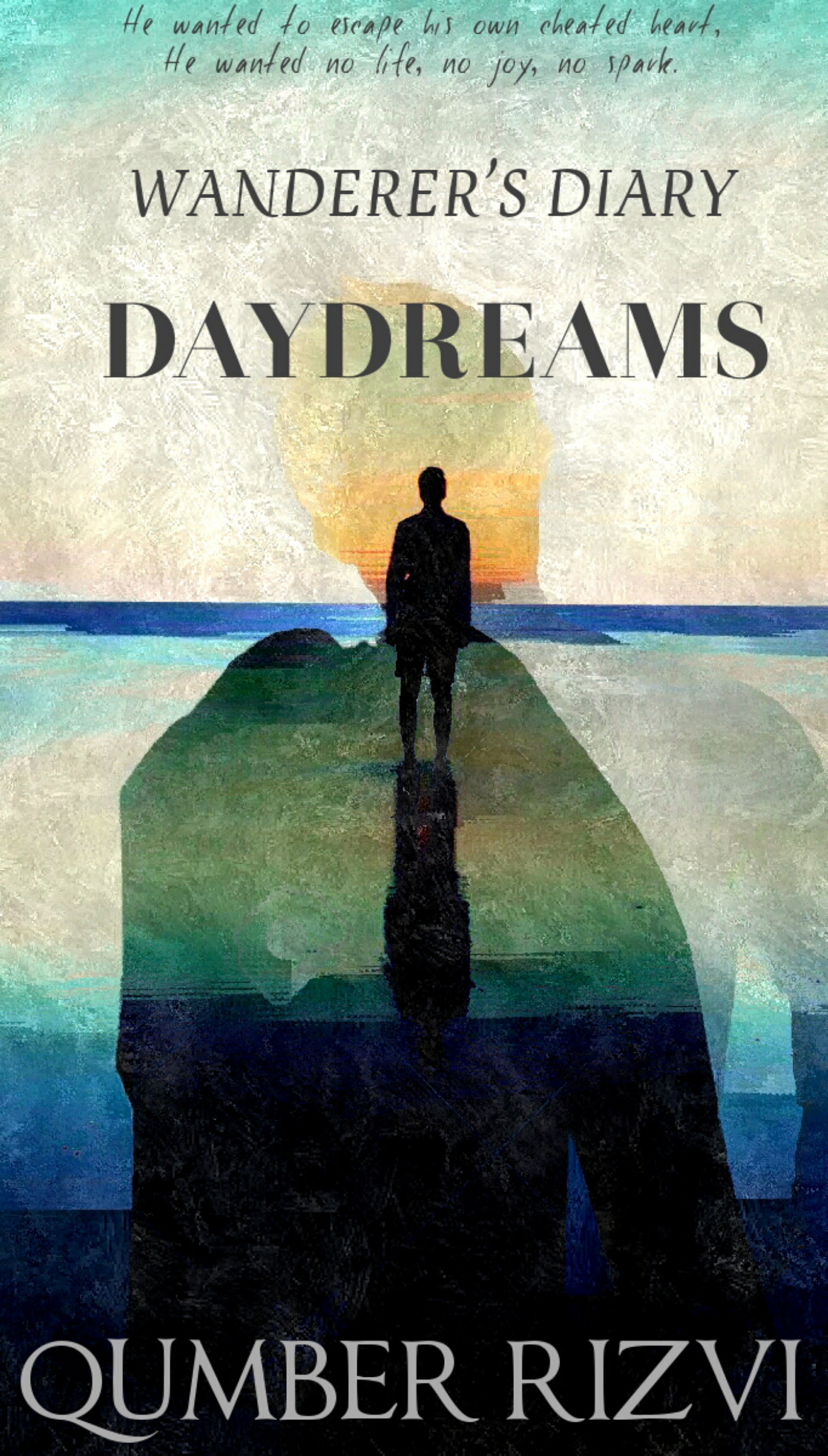
Wanderer’s Diary: Daydreams

The author says:

Wanderer’s Diary: Daydreams is a collection of emotions, friendship, and practical life. The book includes sketches, short stories, an essay, and poems by Qumber Rizvi. A few of the contents are detailed here.


1. Just To Hold Your Hand (Sketch): She fulfills his dream suddenly when she holds his hand and walks with him. He experiences what he had never dreamed of. Or, perhaps, dreamt everyday. Don’t put it down before the climax. There is a BIG twist.


2. Imperfect Us (Sketch): John Smith has a big crush on his classmate. She is the most perfect person he ever met. Even perfect that himself. But what happens when she rejects him? 3. The Best Buddies (Story): Three friends, classmates are the weirdest buddies in the school. They, together, can do what others won’t even think of. A humorous collection of their crazy deeds in their high school.


3. Change In My City (Story): Author returns to his city after six years. Many things are changed there, but what change he observes is what others won’t really see as significant as he does.


Three poems in Wanderer’s Diary: Daydreams are: 1. Forgery 2. I Was Blind, But Now I See 3. Park Bonus Read (Essay) – Internet Is A Boon

Wanderer's Diary Daydreams Large

Wanderer's Diary Daydreams Large

Nathan says:

The great thing about single-author collections with varied content is that the cover doesn’t have to represent any single theme; it just needs to be visually intriguing.  I think you’ve got that here.

The tweaks I would look at are these:

1. The dimensions are a bit elongated — not necessarily a problem, but given that a lot of ecommerce sites such as Amazon create their thumbnails by defining a maximum height, your cover will look smaller in thumbnail and be that much harder to see.  It may seem like a little thing, but of such little things are big things determined.

2. There’s no indication on the cover that this is a collection. In fact, the tagline at the top makes it seem that this is definitely not a collection, but a single story.  (The tagline is also hard to read at normal size, a combination of the irregular typeface and the color behind it that reduces the contrast.)  It seems that both 1. and 2. (partially) can be improved with one edit: Chop the cover down to a 2×3 proportion, sacrificing that blue area at the top of the artwork and the tagline over it.

3. Your name being as unusual as it is, it won’t strike readers immediately as a name.  (I’m not saying that Stephen King’s success comes from being named “Stephen King,” but it didn’t hurt.)  But you can improve this, and solve the other half of 2., by adding “Stories and Poems by” or “A Collection by” above your byline, which will both identify your name as a name and give more of a clue to the contents.

4. Even if we cut off the tagline at the top, that still leaves us with three different fonts on the cover, and all three of them are serif fonts, which tend to clash with each other.  (That’s why you see so many book covers that use two fonts — one serif, one sans serif).  Since the byline is far from the title, you could use a single serif font for both parts of the title (maybe with “Wanderer” in regular weight, and “Daydreams” in bold) without much danger of clashing.  I would definitely remove the italics from “Wanderer’s Diary.”

Other ideas?


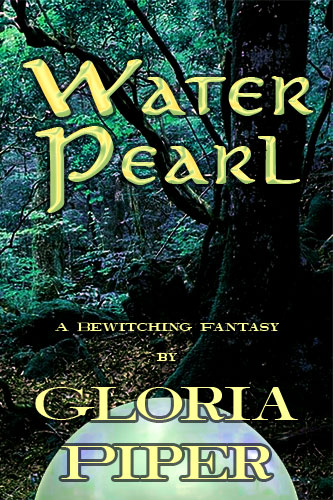
Water Pearl

The author says:

In this fantasy, a magic pearl made of water by a forest sprite serves a major role throughout the story. A youth “borrows” it and aches to return it, but circumstances prevent him until the end.

for-waterpearl-4-png[1]

for-waterpearl-4-png[1]

Nathan says:

The more I do this, the more I become convinced that the two most basic parts of any book cover are:

  1. Color scheme
  2. Typeface(s)

In other words, it would be possible to create an acceptable cover for a fantasy novel using nothing but this photograph, with color manipulation and appropriate fonts.

First: The photograph is too “blah.” It looks like exactly what you’d see if you, well, took a photograph in the forest.  But fantasy needs to be more intense.  What colors could suggest a magical forest? Or magical water?

Second: Neither font you have here is terribly evocative. The Rosetti font you use for the title is ornate, yes, but gets no support from layout or color, and the Comic Sans… Sorry, there is NO appropriate use for Comic Sans.  It’s so overexposed and hated these days, I wouldn’t even use it for a coloring book.

Third: There’s no detail in the background image that you need to be sure not to cover, so the off-center placement of both title and byline accomplish nothing.  You may be trying to achieve a bit of visual interest by breaking the byline into two lines, but its off-centeredness just makes it look haphazard.

Fourth: The “water pearl” doesn’t look much like a pearl. What it mostly looks like is an afterthought.

Now. The good news is that, as this isn’t a complex cover, the fixes don’t need to be time-consuming.  I did an image search and couldn’t find the exact stock photo you used, but I grabbed a more-or-less similar one to do a “five-minute fix” demo for you.

waterpearl

Definitely not the best cover for this, but it’s a quick sketch showing you what I’m talking about.

Anybody else have thoughts?