Category: Covers

BitCoin, Ethereum… Les Cryptomonnaies [resubmit]

The author says:

Explains what cryptocurrencies are, how they fit in our economic system, how to trade them and the risks/rewards involved. This book serves as a introduction to the world of cryptocurrencies and technical trading. Potential readers should get the idea that they could become make money with cryptocurrencies, although there are risks involved.


[original submission and comments here]

Nathan says:

A step forward and a step back here.  The good:

  • Removing the extraneous “pirate” imagery helps to focus the cover.

The bad:

  • The title typeface is, if anything, harder to read than originally.  The font also has kerning issues, especially seen around “y” and “v”.
  • The subtitle font still clashes horribly.
  • By reducing the size of the main “bitcoin in a chest” image, you’ve lost the added clarity you have it by removing the skull and diamonds and made it harder to “read” visually in thumbnail. Giving the Henry Ford quote more space is a mistake, as it’s not something that be read at anything less than full size anyway.

Recommendations:

  • Enlarge the chest like it was on the first cover.
  • Change out the fonts entirely, both title/byline and subtitle.  Remember with the subtitle that the smaller text is, the more readable the font has to be.

Other comments?

Call Me Hans

The author says:

The book is a character-driven historical/literary fiction piece about a Canadian living in Germany during the Second World War. The book follows the main character, Henry Martens, from May 1944. Working for his uncle, a Nazi Party leader and factory owner, Martens has successfully evaded military service until events in his factory bring him to the notice of the Gestapo. From there he’s sent to military training with the German Army, and eventual assignment to a combat unit on the Russian Front. Martens juggles his desire to return home (with conscience intact) with the necessity of toeing the line with his German superiors in order to survive. But the more dedicated a German soldier he becomes, the more he does to survive the war, the more unlikely it will be that he can ever return to family and friends in Canada.

Nathan says:

This cover design looks like a throwback to early ’70s publishing for young readers by Scholastic and the like.  As such, I don’t think it’s hitting your target readers, unless you’re aiming at juveniles with a book that is as much to teach them about history as to tell them a story.

I think you need to go back and look at the other books in your genre, and be clear what your genre is. A wartime drama is a DRAMA (set in wartime). A wartime suspense thriller is a SUSPENSE THRILLER (set in wartime).  Use the cover to convey the type of story first, and the setting second.

Other comments?

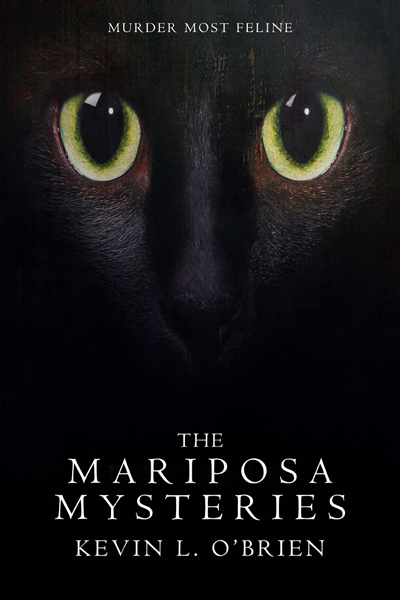
The Mariposa Mysteries

The author says:

A collection of stories set in Victorian England that combine Sherlock Holmes style mysteries with the Cthulhu Mythos. January Ian “Jaim” Mariposa is a paranormal investigator whose partner/companion is a small black cat named Bubastis. That’s Bubastis on the cover. Target audience is cat lovers, mystery lovers, Lovecraft fans.

Nathan says:

The snark in me say that the cover is only missing two things:

  • Holmes-style mysteries.
  • The Cthulhu mythos.

It should be easy to find (or commission for a reasonable fee) something monstrous and Victorian; DeviantArt is awash in images like that.

Lovecraft fans in particular are always on the lookout for a good read, but you’ve got to include something on the cover to let them know that this book is for them — and if it isn’t in the title, it’s gotta be in the image.

Other comments?

As Fingers Seek the Harp

The publisher says:

A collection of poems written between the two World Wars, now being reprinted. The poems are traditional in style, utilizing meter and rhyme. The poems will appeal to those who like this sort of poetry, particularly to nature lovers (about half the poems deal with nature in some way). The other poems cover a variety of topics: love, historical events, literature, patriotism, religious feelings, and others.

I’ve looked around and found some good advice about covers for fiction and non-fiction, but hardly anything about poetry. So I decided to put this draft of the cover up here. Don’t worry about the horizontal placement of the photo; it will bleed off the right and stop at the spine fold on the left (which may not be exactly where I have it at the moment). This cover is not as artistic as many I see here. However, the book itself is simple (just the text, no illustrations or anything) so I thought a straightforward cover was the way to go.

Nathan says:

There’s a difference between “straightforward” and “generic,” and I think you crossed the divide here.

Even with poetry — which has a very limited buying audience, and which (along with lit fic) doesn’t want to appear too lowbrow by using cover that pander to crowd appeal — the cover should convey something beyond “contains poems.”

You mention specifically that these poems are “traditional in style, utilizing meter and rhyme,” which is definitely not the norm these days, most poetry being dominated by free verse.  You should therefore play up the traditional/classic vibe of the cover.  Use a period photograph or painting. Use typefaces such as you would find at the time. Heck, look at poetry book covers (or, lacking those lit magazine covers) from the period and design it as if this book were from that period.  You’ll have better luck finding those readers who want traditional poetic instead of free verse.

Other ideas?